Technology
This section covers how the ADC Portal is secured and how it communicates with your ADCs - the zero-trust model and end-to-end encryption that protect your data, the secure WebSocket channel and the PGP layer that sits inside it, the Shuttle and the other services used to reach each vendor’s appliance, and a worked deployment example.
The ADC Portal is built on a zero-trust security model and uses full end-to-end encryption. This approach ensures that all data within the Portal is always encrypted (both at rest and in transit) using a unique pair of organisation and account private keys. This means that no one can ever see or read your data, and that all data encryption and decryption occurs within your own environment.
Communication
All communication takes place via a secure WebSocket protocol (WSS) with mTLS. With mTLS, the client is required to present its certificate to the server (and vice versa). Hence mutual certificate authentication occurs. This double layer of authentication provides an additional layer of protection against impersonation attacks. And it is only once this two-way authentication has taken place that a secure connection is established, leading to the exchange of data.
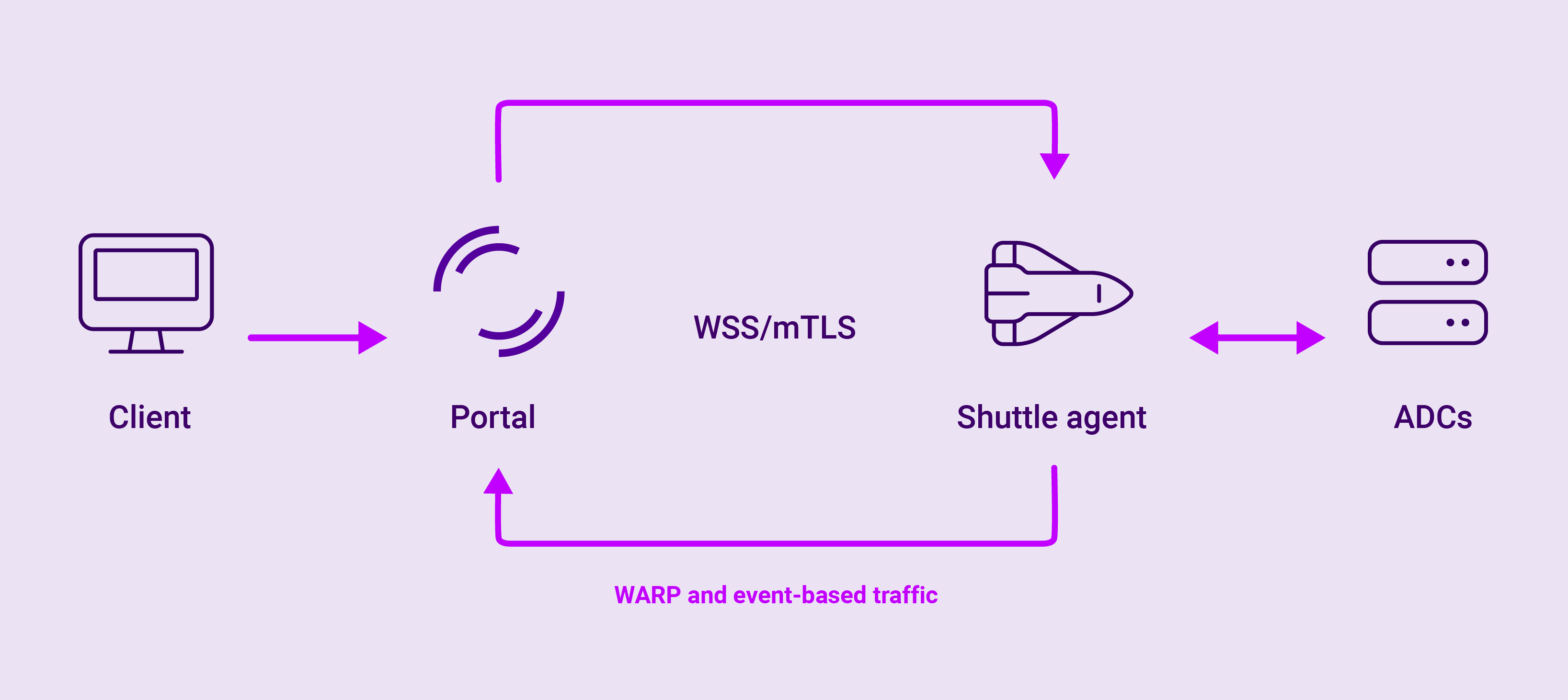
Within this encrypted WSS channel, there are two methods of communication:
Event-driven requests : Explicitly defined requests are sent as events to the Shuttle for added security and efficiency.
Remote HTTP proxy : This is a WARP-enabled, remote HTTP proxy to your network. It allows you to see the WebUI of each appliance and provides a facility to manage it over an encrypted connection across the Loadbalancer.org ADC Portal network.
WARP
WARP is a proxy that helps you connect to the internet while simultaneously optimizing and securing (i.e. encrypting) your connection, giving you access to your appliance, no matter where you are.
PGP Encryption for Extra Security
In addition to the secure WebSocket encryption outlined above, the Portal also contains a second layer of security: PGP encryption.
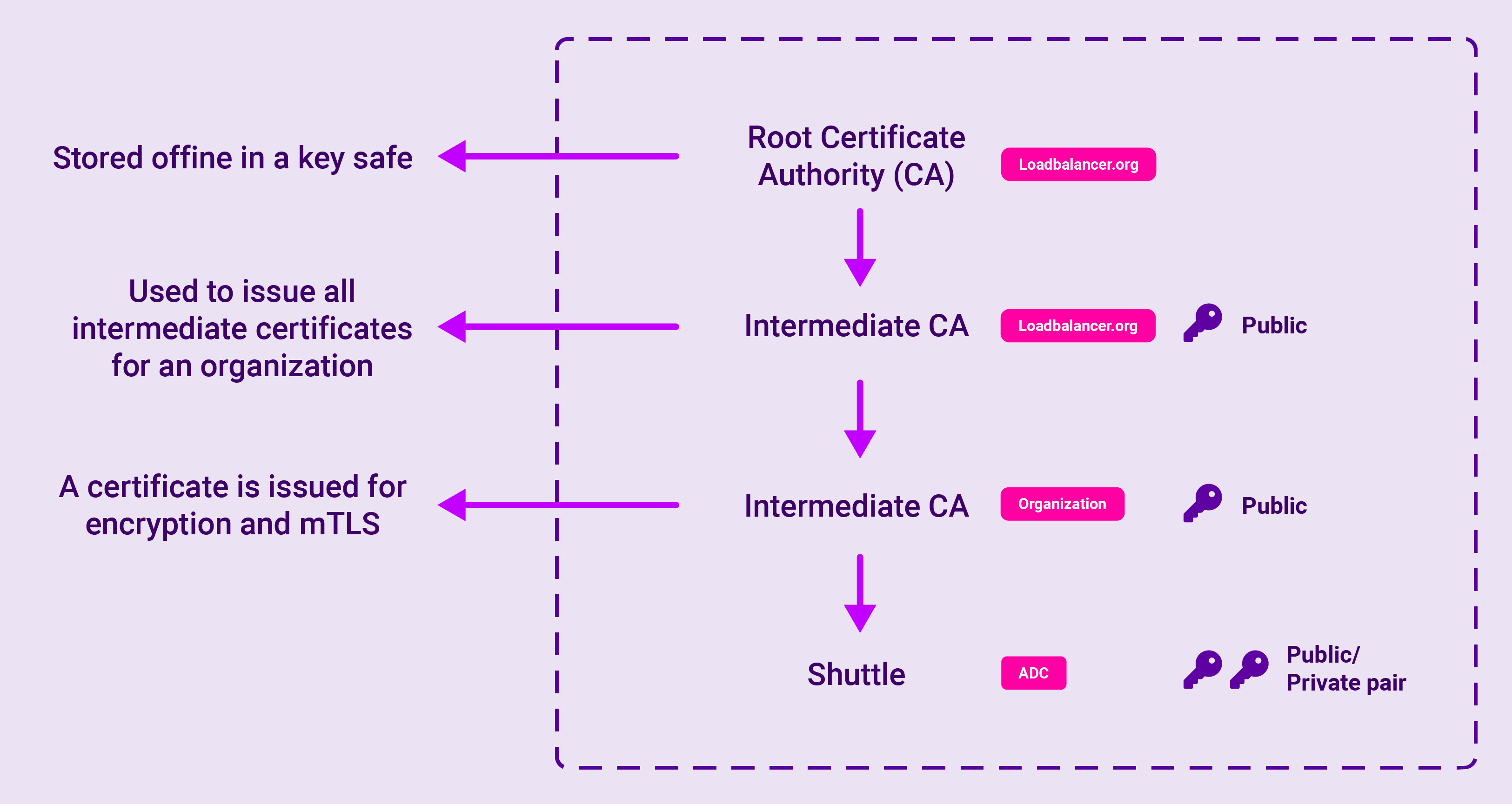
Once the initial mTLS handshake has been completed, the Shuttle then creates its own PGP keys, which are then used for communication and verification with the ADCs. However, before data can be transferred from the client to the Shuttle, it must first pass through an intermediary key. This Certificate Chain enables the receiver to verify that the sender and all Certificate Authorities are trustworthy.
Every user needs not only their own private key, but also a copy of the organisation key to read the data that’s coming in from the Shuttle. This means new users will need to be invited by the organisation to register, and actively given a copy of the organisation key (as well as activating their own private user key). In this way it is the organisation who is the owner of everything - not the user.
And with the potential for multiple levels of encryption using different keys, it would be almost impossible to decrypt what is imprinted on the public key without also being in possession of a private key. In this way, if someone were to compromise or intercept the messages being transmitted by the Shuttle, break the TLS encryption and obtain the encrypted PGP data, they would still need the Shuttle’s private key to be able to read it.
In this way, data communications are sent via the Shuttle which acts as an intermediary or sidecar agent, but the Shuttle is unable to read these messages. Its only role is to act as a vector to forward this information when, and only when, the private and public keys match.
High Availability Shuttles
Multiple Shuttles within the same namespace can operate simultaneously in an N+ Active HA configuration. Shuttles form an encrypted peer-to-peer mesh, sharing a common encryption key via key exchange coordinated through the Portal. ADC credentials are migrated from local Shuttle storage to the Portal, encrypted with the mesh shared key so that only Shuttles in the mesh can decrypt them. The mesh self-heals if a Shuttle goes offline, the Portal detects the stale heartbeat, notifies remaining members, and automatically resolves any subnet conflicts caused by the departed member. New Shuttles joining an existing mesh receive the shared key from a healthy peer and begin operating without manual intervention.
Communication Services & Methods
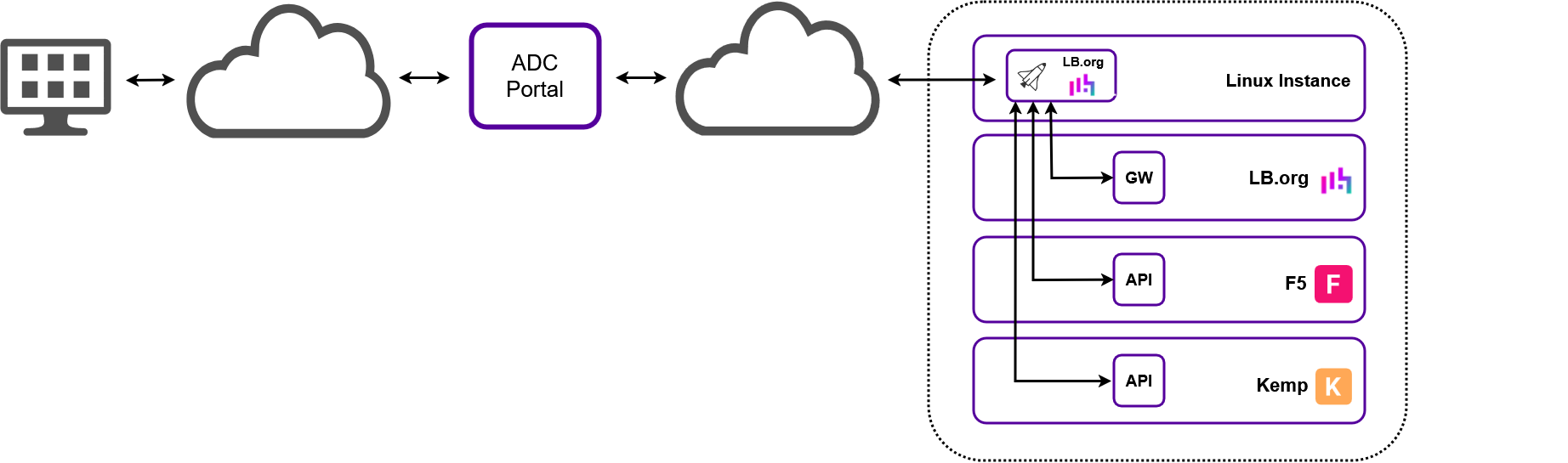
As discussed above, the Shuttle is a key component in ADC portal communication. In addition, the gateway service is used on the Loadbalancer.org Enterprise appliance and API calls are used with the Loadbalancer.org Endurance appliance and 3rd party appliances.
Shuttle Service : Acts as an intermediary sidecar agent for ADCs to communicate with the Portal. Shuttles can be provisioned as a standalone Linux instance running the Shuttle service or as a Loadbalancer.org appliance running its Shuttle service.
Gateway Service : Used on Loadbalancer.org Enterprise appliances to gather appliance details and pass them to the ADC Portal via a Shuttle. It also enables backups and other remote tasks to be run.
Vendor Specific API Calls : Used to gather details for Loadbalancer.org Endurance appliances and appliances from 3rd party vendors and pass them to the ADC Portal via a Shuttle. API calls are also used to control backups and other remote tasks.
Network Topology Considerations
If ADCs are located in remote subnets, the standalone Shuttle can be used (which enables subnets to be configured) - for more information, see Network Topology. Alternatively, one or more Shuttles can be configured in each remote subnet.
Deployment Concept
The following example illustrates how multiple ADCs from various vendors connect to the ADC Portal via a Standalone Linux instance running the Shuttle service.
-
A Loadbalancer.org appliance running its shuttle service can also be used as a Shuttle.
-
Shuttle HA can be provided by adding additional Shuttles within the same namespace.
-
For details on configuring Shuttles, see Shuttle Management.