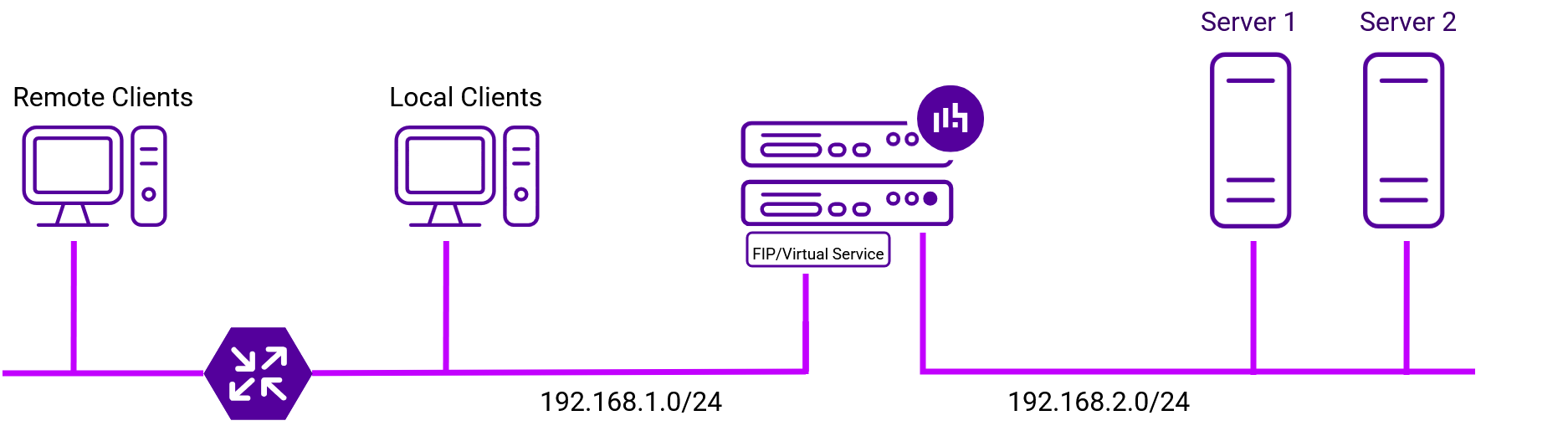
One-Arm and Two-Arm Topologies
The number of "arms" is a descriptive term for how many interfaces are used to connect a device to a network. It’s common for a load balancer that uses a routing method (NAT) to have a two-arm configuration although one-arm is also supported. Proxy based load balancers commonly use a one-arm configuration although two-arm is also supported.
One-Arm
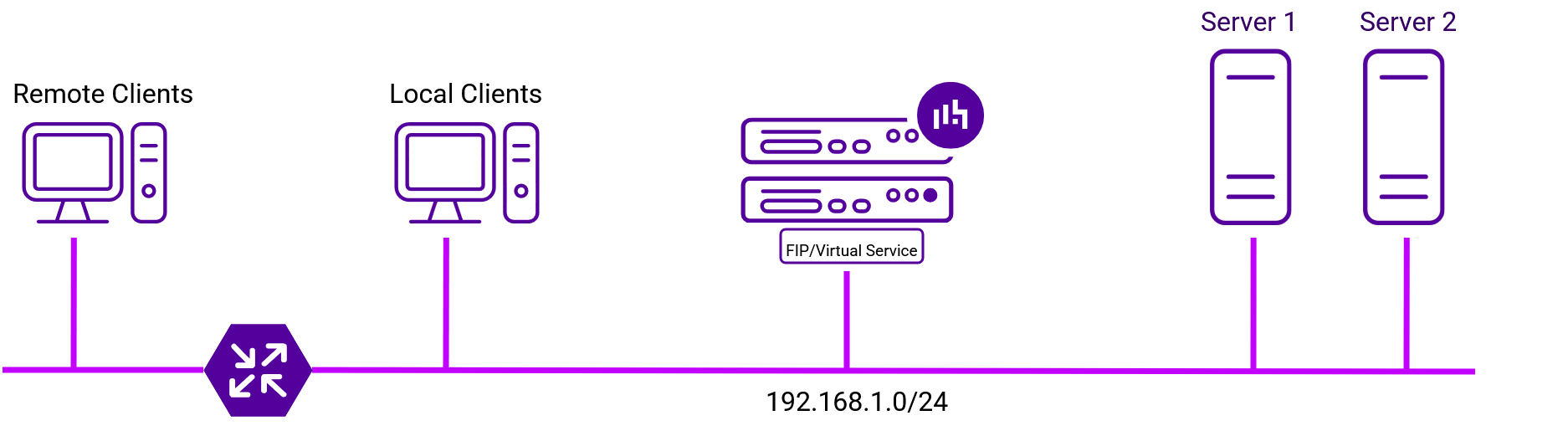
The FIP/Virtual Service and the load balanced servers are located in a single subnet. The load balancer requires a single network interface.
Two-Arm
Here, 2 subnets are used. The FIP/Virtual Service is located in one subnet and the load balanced Real Servers are located in the other. The load balancer requires 2 interfaces, one in each subnet as shown in the diagram below.
| This can be achieved by using two network adapters, or by creating VLANs on a single adapter. |