Services
A service is the load balanced application that clients connect to. This section covers Layer 4, Layer 7 and GSLB services - how each is added, viewed, duplicated and modified - together with the L7 Monitor template and the supporting topics each deployment mode depends on.
The Services menu option opens the Manage services page, which lists every configured service along with its Type (Layer 4, Layer 7 or GSLB), Status, IP address, Ports and Mode.
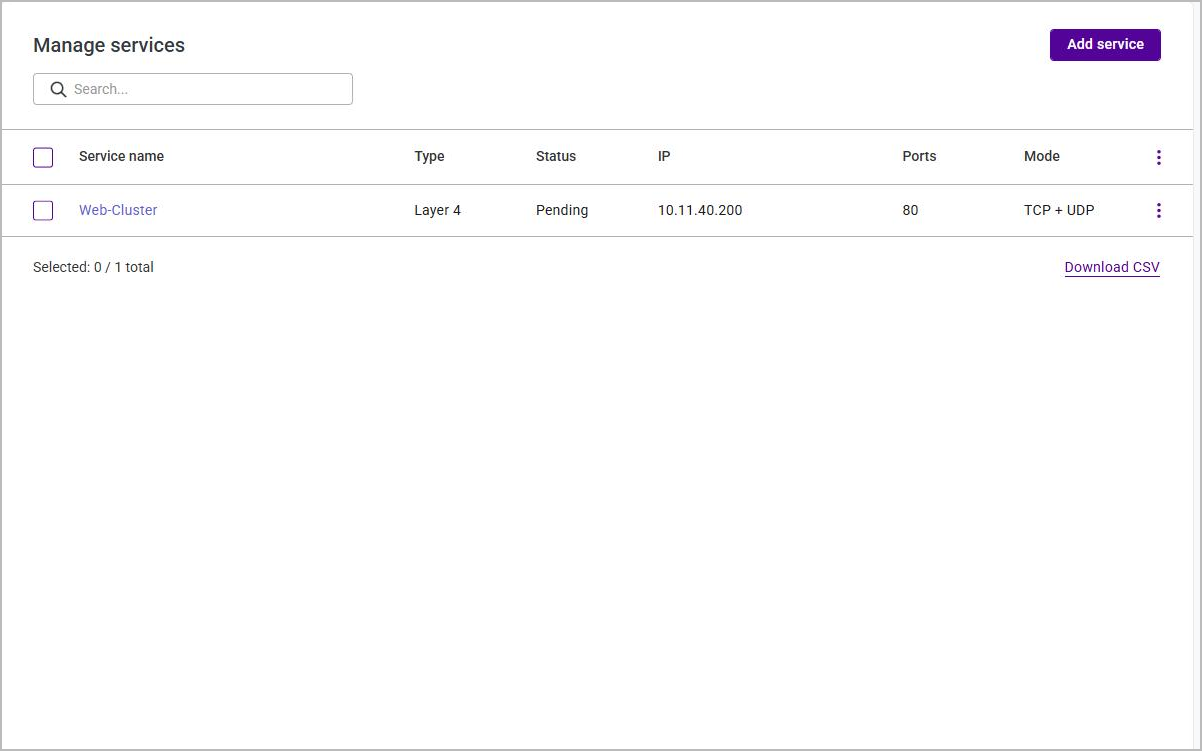
The Search box filters the list. Each row has a checkbox - a counter below the list shows how many of the total are currently selected - and Download CSV exports the list. Clicking a service name opens its Service details page.
The menu at the end of each row provides the following actions:
| Action | Description |
|---|---|
Action required |
Applies the configuration change that is outstanding for the service, without going to System services. A confirmation dialog names the change, for example "Are you sure you want to update nftables, this may take a minute or two." - click Confirm to apply it. |
View stick table |
Opens the Layer 7 stick table page, which lists the persistence (stick) table entries currently held for the service - the ID and Key of each entry, its Use count, when it Expires and the Server it is pinned to. Where the service has more than one backend, Select backend chooses which table is shown. Refresh stick table re-reads the table, and Clear stick table discards every entry in it so that clients are load balanced afresh. |
View graphing |
Opens the Graphing page for the service, which plots Bytes/s received, Bytes/s sent and Connections over the period chosen with the range buttons - 15 minute, Hour and Day, with 1 minute, 5 minute, Week, Month and Year behind More ranges. A separate drop-down sets the time window that is plotted - Last hour, Last 6 hours, Last 24 hours (the default), Last 7 days or Last 30 days - and the page reports the resolution it has used beneath the graphs, for example "Showing one point every 70 seconds". Where the window reaches back further than the recorded history, it adds "The selected time frame starts before the recorded history, so the graph begins where collection does". A Service drop-down switches between services without returning to the list. Only Layer 7 services keep a history, so on a Layer 4 service the option is greyed out and reads "Historical graphs are only available for Layer 7 services." The history is recorded only while Stats tracking is enabled; until some has been collected the page reads "No history has been collected for this service yet." |
Online |
Returns the service to normal operation. |
Drain |
Stops new connections being sent to the service while allowing existing connections to complete. |
Halt |
Immediately stops the service, dropping existing connections. |
Edit |
Re-opens the service in the configuration wizard. |
Duplicate |
Creates a copy of the service, which can then be renamed and modified. |
Delete |
Removes the service. |
| The actions offered vary with the service’s current state. Action required is shown only while a configuration change is outstanding, and Online replaces Halt once the service has been halted - at which point View stick table and Drain are greyed out. Halt, Drain and Online each open a confirmation dialog naming the service; click Confirm to proceed. |
The actions also vary with the type of service. A GSLB service answers DNS queries rather than carrying connections of its own, so View stick table, View graphing, Online, Drain and Halt are not offered for one.
To create a new service, click Add service and select the required template. The following templates are available:
-
Layer 4 Services - high-performance, transport-layer load balancing based on LVS.
-
Layer 7 Services - flexible, content-aware load balancing based on HAProxy.
-
GSLB Services - Global Server Load Balancing based on Polaris.
-
L7 Monitor - sets up a frontend monitor. A Layer 7 service in HTTP mode must already exist to use this template; until one does, the template is greyed out and cannot be selected.
-
Import a template - creates a service by importing a previously exported service template file from your local machine.
Having selected a template, step through the configuration wizard. The sections below describe the Layer 4, Layer 7 and GSLB service types in detail.
| When stepping through a service wizard, a Save template option is also available. This exports the current service configuration as a template file, which can later be re-imported using the Import a template option above. |